Why Does Your Company Need an ERP System?
Your Company Is Growing. Are Your Systems Keeping Up?
Picture a company that started with a small team. Sales lived in Excel, inventory in a separate program, and accounting in yet another system. At first, everything works and people can keep up.
But as orders, products, and customers multiply, the cracks start to show:
- Sales takes orders for products that aren’t actually in stock.
- Accounting waits on reports from other departments to see the real numbers.
- Purchasing has no clear view of what the warehouses need.
- Managers pull data from several systems just to see how the company is doing.
The problem isn’t necessarily your people or your software. It’s that every department is working from its own separate data. That’s where ERP comes in.
What Is ERP?
ERP stands for Enterprise Resource Planning. In simple terms, it’s a system that helps a company run its core operations from one place and connects data and processes across departments.
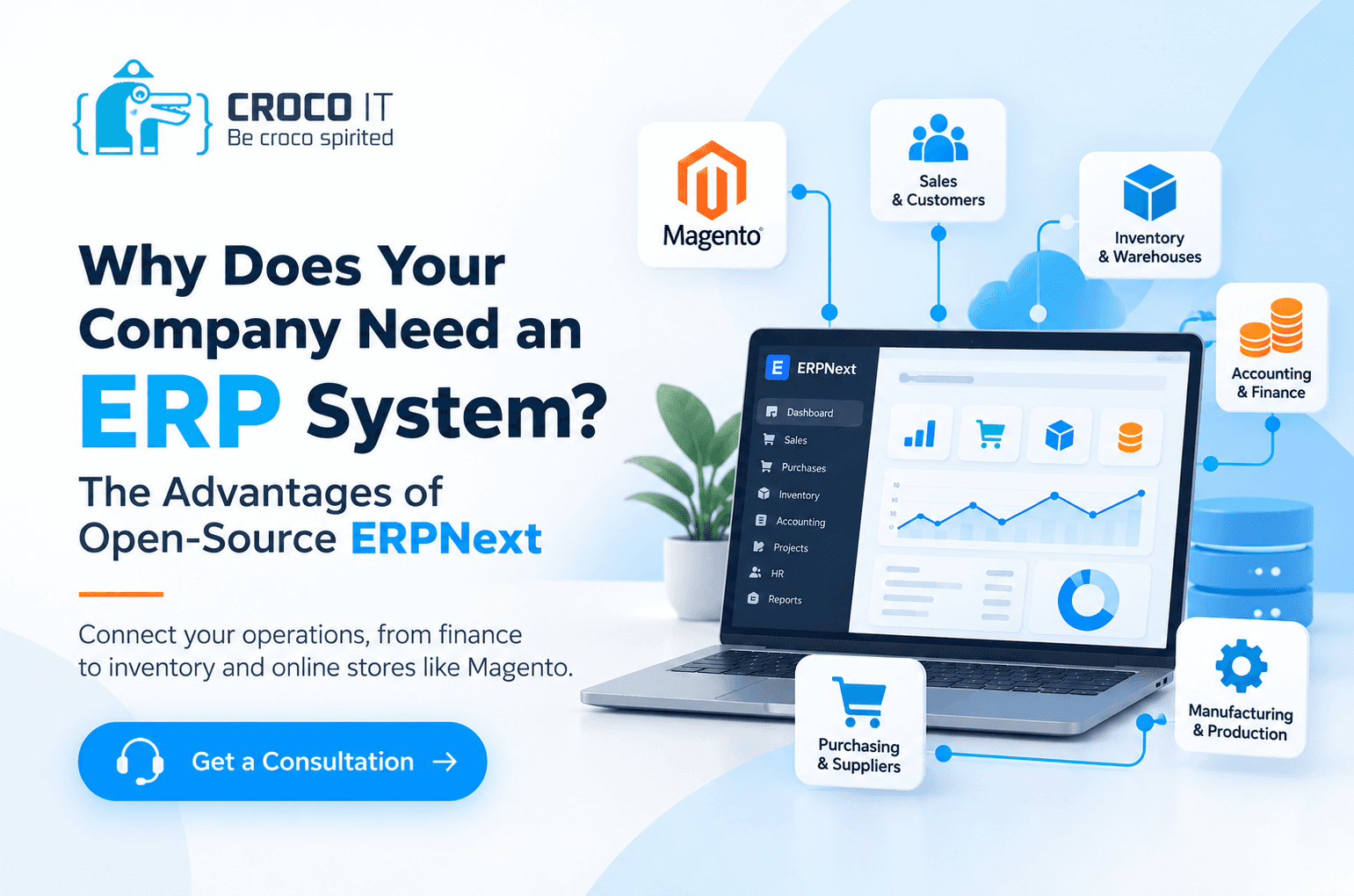
Instead of every team using its own standalone tool, an ERP brings operations together in one connected system, which can include:
- Accounting and finance.
- Sales and customers.
- Purchasing and suppliers.
- Inventory and warehouses.
- Manufacturing and production.
- Projects and services.
- Human resources, depending on the system and the apps you use.
The goal isn’t just to collect data. It’s to turn it into connected information that helps your company run efficiently and make better decisions.
Why Does Your Company Need an ERP System?
1. One Version of the Truth, Instead of Scattered Files and Programs
When sales, inventory, and purchasing data are linked, every department works from a shared source of information. That cuts down on duplicate data entry and helps you spot discrepancies faster.
The benefit: more consistent information and less time spent reconciling data between teams.
2. Streamlined Operations and Fewer Manual Errors
Imagine a salesperson creates a sales order. In a properly configured ERP, that order can flow through to preparing the goods, delivering them, issuing the invoice, and recording the financial entry, rather than someone re-entering the same data into a different program at every stage.
The benefit: less repetitive work and a better-organized order cycle from start to finish.
3. More Accurate Inventory and Purchasing
Companies with multiple products and warehouses need to know what’s available, how stock is moving, which orders are pending, and what needs to be bought. Linking inventory with sales and purchasing helps you plan better and avoid buying decisions based on outdated data.
The benefit: a clearer view of goods in motion and better inventory management.
4. Decisions Based on Numbers
Instead of waiting until month-end to compile reports, a manager can use dashboards and reports inside the ERP to track sales, expenses, receivables, and stock movement. Of course, report accuracy depends on the quality of the data and the processes you’ve set up.
The benefit: faster performance tracking and decisions grounded in clearer information.
5. A System That Grows with Your Company
When a company opens new branches, adds warehouses, or expands its team, tracking everything by hand gets harder. The right ERP helps you organize that growth instead of rebuilding your processes with every expansion.
This applies to small businesses with growth plans, mid-sized companies, and larger organizations with complex operations.
Why ERPNext in Particular?
Not every ERP offers the same capabilities, licensing model, or level of control.
ERPNext is an integrated enterprise resource planning system built on the Frappe Framework, and it’s open source. That means you can use, host, develop, and customize it to fit your needs, subject to its license terms.
One of its biggest strengths is that it brings operational and financial functions together in a single system, instead of relying on a patchwork of disconnected programs.
7 Key Advantages of ERPNext
1. Open Source: More Control Over Your Company’s System
This is one of ERPNext’s most important advantages. Because the system is open source, its code is available to inspect and extend, and you don’t have to depend on a single company to modify or host it.
You choose your development partner, decide where it’s hosted, and build customizations that match how your company works.
The benefit: greater flexibility in development and less dependence on a single vendor.
2. No License Fee for the Core Software
ERPNext is available as an open-source project with no license fee for the core software when you self-host it. But that doesn’t mean setting it up and running it is entirely free. You’ll need to budget for hosting, setup, data migration, customization, staff training, and ongoing maintenance and support.
The benefit: the chance to invest in implementation and development rather than paying a license fee for the core software.
3. Run Your Departments from One System
ERPNext offers a connected set of capabilities that covers accounting, sales, purchasing, inventory, manufacturing, projects, and customer relationship management. A distribution company, for example, can use it to follow customer orders, inventory, purchasing, and invoices through connected processes.
The benefit: less scattered data and easier coordination between departments.
4. Customize It to the Way You Work
Every company has its own procedures. One company may need a manager’s approval before purchases above a certain value are confirmed. Another may need extra customer fields or management-specific reports.
With the capabilities of ERPNext and the Frappe Framework, you can build custom fields, forms, workflows, and applications to match your requirements.
The benefit: the ability to adapt the system to your business processes, instead of being limited to fixed settings.
5. Connect It to Your Online Store and Other Systems
Companies don’t run on ERP alone. You may also have an online store on Magento or another platform, a mobile app, a point-of-sale system, shipping providers, and payment gateways. Integrations between ERPNext and these systems can be built using APIs and the right integration tools.
For example: a customer places an order in your online store, the order data is sent to ERPNext, and once the order is reviewed and fulfilled, its status is updated back in the store.
Integrations like this need to be designed, built, and tested. They aren’t necessarily ready to go for every platform from day one.
The benefit: your sales channels and internal operations stay connected, with less manual data entry.
6. Flexible Hosting
You can host ERPNext on your company’s own infrastructure, on a VPS, in a suitable cloud environment, or through a managed hosting service that supports it. That lets you choose the model that fits your operating scale, security policies, and budget.
The benefit: more freedom to choose your environment and control its costs.
7. Built to Scale and Evolve
You can start with sales, inventory, and accounting, then expand the system to cover more departments and processes. As you grow, you can improve the infrastructure and develop new capabilities to match your needs.
Just keep in mind that scaling successfully depends on the quality of the implementation, server capacity, the design of your customizations, and performance testing.
The benefit: a system that evolves with your business instead of a series of disconnected stopgaps.
A Practical Example: A Company with an Online Store and Two Warehouses
Let’s say a company sells its products through an online store and has one warehouse in Cairo and another in Alexandria.
Before ERP, the sales team might rely on a separate file for stock quantities, the warehouses log their movements in another program, and accounting tracks invoices on its own.
After implementing ERPNext and connecting it to the store properly, the workflow could look like this:
- A customer places an order in the online store.
- The order data flows into ERPNext.
- The operations team reviews the order and the available quantities.
- The order is prepared and the stock movement is recorded.
- Financial documents are generated according to the approved workflow.
- Order status updates are sent back to the store.
The expected result is less duplicated data and better tracking of each order from sale through fulfillment and collection.
Is ERPNext Right for Small and Large Companies?
Small businesses. It can be a good fit once operations start to get complicated and you need accounting, sales, and inventory working together. But if your business is very simple, a basic accounting or inventory tool may be enough for the first stage.
Mid-sized companies. It’s an option worth evaluating as branches, staff, and order volumes grow, and you need unified procedures and connected reporting.
Large companies. It can support broad, multi-faceted operations, but you’ll want to assess complex requirements, what the system can cover, integrations, performance, and compliance before deciding.
Company size alone isn’t enough to choose an ERP. What matters most is the nature of your operations and how complex they are.
Is ERPNext a Good Fit for Companies in Egypt, Saudi Arabia, and the Gulf?
ERPNext can be set up to work in different markets, with the right configuration of currencies, taxes, documents, language, and local integrations.
It’s important to be clear, though, that legal requirements such as e-invoicing, taxes, and integration with regulatory authorities aren’t necessarily ready for every country out of the box. They may need configuration or development.
That’s why you should review local requirements and confirm that the solution complies with them before going live.
Does Open Source Mean a System Is Less Secure?
Not necessarily.
Security depends on the quality of the system’s development and updates, how it’s hosted, how user permissions are set up, and how connections and backups are protected. Being open source is neither a guarantee of security nor a sign of weakness.
What matters most is having a team responsible for updates, monitoring, maintenance, and testing that data can actually be restored.
How Croco IT Can Help Your Company
At Croco IT, we believe a successful ERP isn’t just about installing software. It’s about understanding how your company works and turning it into connected, measurable processes.
We can help you evaluate your needs and design the right solution, including:
- Analyzing your processes and defining your ERP requirements.
- Assessing how well ERPNext fits your business.
- Setting up and hosting the system and preparing it for production.
- Customizing functions, approval workflows, and reports.
- Developing integrations with Magento and other online stores and systems.
- Helping with data migration, testing, and user training.
- Providing support and maintenance, scoped to the agreement.
Our goal is for the system to serve the way you work and help you organize your operations, not become one more tool that adds complexity.
Conclusion: Does Your Company Need ERPNext?
If your company struggles with scattered data, heavy manual work, or difficulty tracking inventory, sales, and accounting, that’s a sign it’s worth considering an ERP system.
And if you’re looking for a system with connected functions, more control over customization and hosting, and no license fee for the core software, ERPNext deserves a place on your shortlist.
The right decision isn’t choosing the most famous ERP. It’s choosing the one that fits your company’s operations and can evolve with them.
Thinking about implementing a new ERP, or connecting your existing systems? Book a consultation with the Croco IT team and let’s talk through your company’s needs and the right solution for them.
ERPNext FAQ
Is ERPNext free?
The core software is open source and can be used without a license fee, but hosting, customization, implementation, and support may be paid services.
What’s the difference between ERP and accounting software?
Accounting software focuses mainly on financial transactions and reporting. An ERP connects accounting with other operations such as sales, purchasing, inventory, and manufacturing.
Can I connect ERPNext to a Magento store?
Yes. An integration can be developed using APIs to exchange product, inventory, and order data, depending on your company’s needs.
Does ERPNext support more than one warehouse?
Yes. It provides functions for managing warehouses and stock movements across multiple locations.
Can ERPNext be customized to fit my company?
Yes. It supports customization through system settings, the capabilities of the Frappe Framework, and custom development.
Is ERPNext suitable for large companies?
It can be, but the decision needs a close look at the scale of your operations and data, integrations, required functionality, and performance.